By Jim Johnson
SENIOR STAFF REPORTER
Published: March 20, 2014 1:11 pm ET
Updated: March 20, 2014 1:27 pm ET
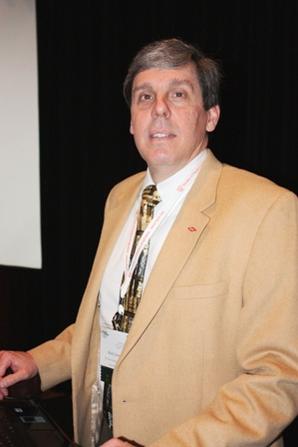
Image By: Jim Johnson
Mark E. Jones of Dow Chemical Co.
ORLANDO, FLA. — Mark E. Jones is the kind of guy who will change his diet for the sake of his environmental footprint.
He’s the kind of guy who uses a meter to determine just how much electricity is wasted by leaving a charger plugged in to the wall when not in use.
Jones, employed as a research fellow by Dow Chemical Co., is the kind of guy who wants to look beyond the obvious when considering the value of materials, plastics included.
And he figures it would be helpful if everyone adopts such a view.
“You can’t tell anything about sustainability just by looking at the material,” Jones said in a presentation at the recent Global Plastics Environmental Conference in Orlando. “What you have to know is something about the life cycle.”
Where the material came from, its extraction, processing, design, manufacture, distribution, use, repair and, finally, disposal also have a say in determining sustainability. “That’s the only way to know whether it truly is sustainable,” he said.
Without this kind of world view, it all comes down to guessing.
“People want it to be easy. They want to be able to look at something and determine its sustainability,” he said.
But that doesn’t work, said Jones, who now buys vegetable protein over beef because of its lower environmental footprint.
“Last night, in Midland, Mich., I know two people were eating beef, my wife and my daughter. Because once I started looking at this and realized what the footprint of meat is, I knew I should cut down beef,” he said.
Jones said society needs to spend time on “things that really move the needle” rather than topics that might be popular but have less impact when it comes to sustainability.
“We go off and look at these shiny things in the corner that don’t seem to move the needle,” he said.
“The issue is people don’t want to think hard about these things. They want it to be easy. These are very difficult questions,’ he said.
Such a life-cycle analysis, Jones said, is useful when comparing compact fluorescent light bulbs vs. incandescent bulbs, for example.
And incandescent bulb takes about 300 watts of energy to make while a CFL takes about two kilowatts. But when looking at the lifecycle of both products, it becomes clear that a CFL is a more sustainable product in the long run thanks to reduced energy consumption during operation.
That kind of wider view is helpful when considering the usefulness of plastics, he said. “The reality is that plastics provide a lot of benefit.”
“If we want society to understand what our products do, we have to talk about the cost … but also talk about the benefits,” he said.
GPEC was organized by the Plastics Environmental Division of the Society of Plastics Engineers. |