By Gayle S. Putrich
STAFF REPORTER
Published: April 29, 2014 7:36 pm ET
Updated: April 29, 2014 7:44 pm ET
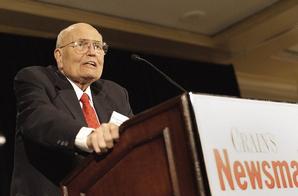
Image By: Crain's Detroit BusinessU.S. Rep. John Dingell, on the likelihood of a new chemical regulation bill: “This legislation has been sitting around and sitting around and it will probably sit around until hell freezes over.”
WASHINGTON — Of course Congress’ inability to get things done extends to plastics and chemicals.
Last spring, when co-authors Sen. David Vitter, R-La., and the late Sen. Frank Lautenberg, D-N.J., introduced a compromise bill to revamp the 1976 Toxic Substances Control Act (TSCA), it seemed enthusiasm and urgency would easily pave the way for a more modern U.S. chemical regulation.
Then industry and environmental groups got involved, in favor and not. The House drafted its own version of the Vitter-Lautenberg bill. Letters were sent. Hearings were held. More letters were sent. Draft bills were redrafted.
Members of one party accused members of the other party of not allowing their input; members of the other party accused members of the first party of never actually submitting their input even though they were asked for it six weeks ago. Even the subcommittee chairman — and author of the bill — Rep. John Shimkus (R-Ill.) said the whole “junior high process” is “a tad frustrating.”
And even with an updated draft of attempt to reform 1970s-era chemical regulation legislation, the complaints continue to sound more or less the same.
At the April 29 hearing on a revised version of the Chemicals in Commerce Act (CICA), Rep. John Dingell (D-Mich.) the longest-serving member of the House, put it best: “This legislation has been sitting around and sitting around and it will probably sit around until hell freezes over.”
Concerns voiced from some House Democrats and environmental groups in the seventh related hearing continued to focus on the same handful of issues as they have for months, including how chemical exposure for vulnerable populations like babies and pregnant women will be considered, the possibility that the patchwork of state regulations will be preempted by a new federal law, and what kind of cost-benefit analysis the U.S. Environmental Protection Agency (EPA) should use to determine if a chemical should be banned or restricted — and, sometimes, even if it should be called a “cost-benefit analysis.”
But some experts testified that the revisions were an improvement over the last version of the bill.
“The improvements to the testing provisions of TSCA will reduce EPA’s current regulatory burdens when new information is needed because available information is insufficient,” said Cal Dooley, president of the American Chemistry Council and a former member of the House. “The expansion of the EPA’s authority to mandate testing for prioritization purposes is a significant change that ACC can support.”
Beth Bosley, president of Boron Specialties, representing the Society of Chemical Manufactures and Affiliates (SOCMA) and testifying on TSCA reform for the third time, said risk evaluation and risk management are better defined in the revised version of the bill, making the former’s solely health-based standards clear.
“As for the risk management process, we support the bill’s requirement that restrictions on uses of chemicals be cost-effective. However, we are concerned that the bill would allow EPA to ban a chemical even when it concludes that there are no technically and economically feasible safer alternatives,” she said. “We are still vetting this change, but it seems to us that EPA should not be allowed to increase overall risk to public health by banning or substantially limiting a chemical."
Mark Greenwood, a former director of EPA's Office of Pollution Prevention and Toxics who now runs Greenwood Environmental Council PLLC, said that if he had been given the choice between the bill he was faced with implementing as an EPA official in the 1990s and the current draft, he would choose the current draft bill.
Greenwood also warned against the growing patchwork of state regulations and outright bans on chemicals and products that have cropped up in the absence of effective federal legislation even in the face of a letter from 13 states attorneys general opposing the bill because of possible preemption of their laws.
“If you are going to try to advance the interests of the United States and engage with the other parts of the world in trade, you have to have a consistent position. One country, one voice,” Greenwood said. “Our trading partners don’t want to have to negotiate with the individual sates of the United States. They expect that the federal government speaks for the entire country.”
Republicans and Democrats do agree that U.S. chemical regulations need to be updated, and some hopeful Democrats said they had not given up hope of a viable bill yet.
The latest draft bill is "moving the ball forward a little bit" said Rep. Diana DeGette (D-Colo.), but there is still more work to be done and she intends to bring Democrats together to work out details disagreements on the bill within their own caucus and “submit some specific language to address specific concerns.” |