By Bill Bregar
SENIOR STAFF REPORTER
Published: May 21, 2014 4:03 pm ET
Updated: May 21, 2014 4:07 pm ET
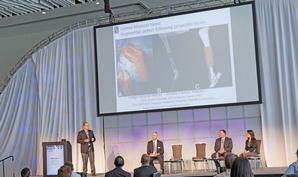
Image By: Janet Century
Matthew Becker, left, said researchers are developing ways to use plastics in emergency situations on the battlefield.
CLEVELAND — Researchers in Akron, Ohio, are developing an extruded tube that one day could help repair the legs of soldiers injured by roadside bombs, University of Akron professor Matthew Becker said at the Plastics in Medical Devices conference.
The hollow, degradable device, designed for healing a femur bone, is made of amino acid-based poly(ester urea).
“It looks basically like a toilet paper roll,” Becker said.
Becker leads the biomaterials efforts of the Austen BioInnovation Institute in Akron, which fosters innovation and collaboration at UA and Akron-area hospitals. He was one of three Austen BioInnovation officials to talk about future biomaterials for medical use, such as spinal disc replacements and artificial ligaments.
The tube has been tested on the broken femurs of sheep. Becker said the military wants this technology because too often, doctors are forced to amputate soldiers badly hurt by improvised explosive devices. The degradable scaffold tube is extruded in about 18-inch sections. He said the University of Akron is one of only three universities in the United States that have an extruder to make it.
Bone eventually grows around the tube.
IEDs can cause devastating injuries — burns and vascular damage, and often the wound is filled with dirt. Becker said military doctors ideally want to do only a single surgery, because often, there is not much soft tissue left.
Polymers play a major role in biomedical products, Becker said. He encouraged attendees to ignore the naysayers and keep trying.
“The hardest part of doing something like this is getting over the fact that one, it hasn’t been done before. Two, a lot of people think you’re crazy. The third thing is, it’s not what the normal field would expect you to do,” he said.
Stephen Fening, director of orthopedic devices at the Austen BioInnovation Institute’s Medical Device Development Center, said it’s a challenge to develop biomaterials, which are intended to interface with a biological system, or replace or augment tissue. The body tends to reject “foreign” objects. And human tissues have the ability heal; biomaterials do not, he said.
Fening said three areas of promise are replacement and repair products, devices for controlled-release delivery of medicine and bio-sensing and automation devices.
Fening also is director of research and innovation at the Hoyt Musculoskeletal Research Laboratory at Akron’s Summa Health System. Before, he directed the Cleveland Clinic’s Department of Sports Health Research.
Rob Ngungu, director of regulatory affairs at Austen BioInnovation Institute, gave a 101-style talk on dealing with the U.S. Food and Drug Administration. He advised conference attendees to think about FDA issues early in the development process, especially when selecting materials.
“It’s never too early,” he said. “It’s always a good idea to start exploring, what are the regulatory implications of getting into any of these spaces.”
Look at the clinical history and regulatory issues of similar devices and materials, Ngungu said. Try and see if FDA has a comfort level with that type of material, or has expressed concerns. “Novel, unproven materials” that may require a unique development process — and can raise potential questions about safety and risk — makes it much harder to meet FDA approval, he said.
He said companies should take advantage of FDA’s pre-submission process and meet with them. Think in advance about what questions that the agency will have, and bring along the full, appropriate data. Learn about how you will store the materials and how to characterize the material. |