By Nina Ying Sun
ASSISTANT MANAGING EDITOR
Published: June 5, 2014 1:04 pm ET
Updated: June 5, 2014 1:08 pm ET
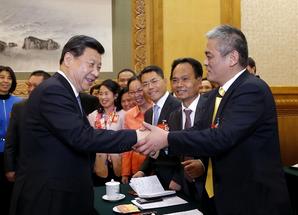
Image By: Kingfa Sci. & Tech. Co. Ltd.
Kingfa Chairman Yuan Zhimin, right, was received by China's President Xi Jinping at the annual session of National People's Congress in March 2014.
SHANGHAI — Millions of acres of farmland in China are growing opportunities for Kingfa Sci. & Tech. Co. Ltd.’s biodegradable plastics business.
Kingfa, which claims to be Asia’s largest and the world’s fourth-largest plastics compounder, has 30,000 metric tons of polybutylene succinate (PBSA) production capacity, behind only market leader BASF SE.
Most of the output is exported to Europe and North America, and only 10 percent is consumed within China, said Kin Wong, sales general manager of Kingfa’s Ecopond bioplastics business. He spoke with Plastics News at the recent Chinaplas show in Shanghai.
But that’s about to change, with the kind of support that only the Chinese government would be able to provide.
Xinjiang Production and Construction Corps (XPCC), a semi-military governmental organization with factory farms in China’s northwest frontier, has agreed to use biodegradable agricultural film made with Kingfa’s PBSA on 140,000 mu (23,063 acres) of its farmland in 2014. The number will increase to 1 million mu (164,736 acres) next year and to 6 million mu (988,422 acres) in 2016, according to Kingfa filings with the Shanghai Stock Exchange.
Kingfa’s founding Chairman Yuan Zhimin has been leveraging his role as a member of China’s legislative body National People’s Congress to advocate for biodegradable plastics. For two years in a row, he has filed motions that proposed wider use of biodegradable plastic films as a solution to China’s white pollution.
Xinjiang, China’s largest region in terms of the usage of greenhouse films, has discovered more than 20 kilograms of petroleum-based film buried in the topsoil per 1 mu (7,176 square feet) of cotton fields, thanks to more than two decades of accumulation, Kingfa said.
Efforts to promote the recycling of greenhouse films have been very ineffective in China, because the ultrathin films easily break down into pieces, requiring intensive labor to collect them from the fields.
It’s very unlikely that China will pass legislations to raise the minimum thickness of greenhouse films and consequently improve their recyclability, Yuan told the Chinese press.
This year’s trial of 140,000 mu of land in Xinjiang translates to more than 800 tons of film, according to film converter for the project Xinjiang Tianye (Group) Co. Ltd., which is a state-owned enterprise under XPCC. Based on that formula, the project will need about 5,700 tons of PBSA films in 2015 and about 35,000 tons in 2016.
In addition to the aggressive push to expand the market penetration of PBSA films, Kingfa is also hoping for government incentives to make PBSA films more price-competitive to all farmers in China. These biodegradable films currently cost twice as much as traditional PE films, Wong said.
PBSA prices dropped more than 30 percent in 2013 from 60,000 yuan ($9,618) per metric ton to 40,000 yuan ($6,412) per ton, Yuan said. Combining that with down-gauging from 15 microns to 9 microns, overall costs of PBSA films are 60 percent lower than before, he added.
Kingfa is also looking beyond the Xinjiang region. Wong said the company has established more than 30 testing sites across the country, carrying out tests over the next four years. “We are researching how to work with the local climate, temperature and moisture in different regions and use PBSA films to help increase farming productivity.”
China annually uses a total of 120,000 metric tons of agricultural plastic films on 300 million mu (50 million acres) of farmland, he added.
In order to meet the upcoming demand surge, Kingfa is mulling the addition of a new line in Zhuhai to double its PBSA capacity, Wong said, but no details are available at the moment. “The timing depends on the progress of the Xinjiang project and the implementation of EU’s plastic bag ban.”
In Europe, Kingfa has been working with an unnamed farming equipment manufacturer to promote the use of biodegradable greenhouse films.
Besides agricultural films, Kingfa’s PBSA is also used to make shopping bags and trash bags for kitchen waste. |