By Catherine Kavanaugh
STAFF REPORTER
Published: September 24, 2014 2:24 pm ET
Updated: September 24, 2014 3:03 pm ET
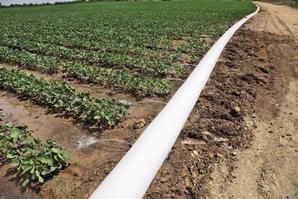
Image By: Delta Plastics
Delta Plastics developed a solution to high irrigation demand in the Mississippi Delta.
Fertile soil, flat to gently rolling land and long growing seasons make the Mississippi Delta a major producer of cotton, corn, sugar, rice and soybeans — crops that give root to an agrarian economy going back hundreds of years.
However, water demand for irrigation and declining aquifer levels make water conservation a major concern in this distinct region that takes in parts of Mississippi, Arkansas, Louisiana, Missouri and Tennessee.
With some 4 million acres of farm land — one of the largest contiguous farm belts in the United States — the Delta isn’t immune to worries that water needs will outpace supply. In Mississippi, farmers are installing irrigation well meters so the state can monitor how much water is being pumped for agriculture. And Arkansas officials project a groundwater gap as large as 7 million acre-feet per year for 2050 if nothing is done.
Delta Plastics wants to be part of the solution. The Little Rock, Ark.-based company, which manufactures polyethylene irrigation tubes, or polytubes, is offering farmers free access to a web-based program that plots out the most efficient way to water furrowed fields.
Called Pipe Planner, this digital design tool allows growers to input information about crop row spacing, elevation and water well volumes and then get back an analysis of what kind of polytube is needed, where they should punch the irrigation holes, how they should vary the hole sizes, and how long it will take to uniformly water the field.
“Pipe Planner allows the field to get even water distribution. You don’t have any wasted water or what is called tail water. It saves an average of 25 to 50 percent in terms of water consumption. It’s dramatic,” Delta Plastics President Sean Whiteley said in a telephone interview.
In the pipeline
Pipe Planner took almost five years and “millions of dollars” to develop, he added, but the company is making it available at no charge to growers as part of the Delta Plastics H2O Initiative. If widely adopted, the initiative could meet its goal of reducing water usage by 20 percent by 2020.
“We’re very excited about it,” Whiteley said. “We estimate if every irrigated acre in the Delta used Pipe Planner the growers in the region could save more than a trillion gallons of water per year. It’s a huge, huge number.”
Growers also can save on the diesel fuel or electricity needed to power water pumps.
“That’s $50 million to $100 million of energy costs they can eliminate by using Pipe Planner to make their irrigation more efficient,” Whiteley said.
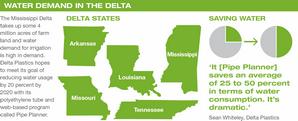
Image By: Graphid by Jessica Jordan
Delta Plastics had been charging farmers and agricultural consultants about $4 to $8 an acre to use Pipe Planner until talks about water shortages intensified. Mississippi farmers just squeaked by a June 30 deadline to voluntarily monitor 5 percent of their irrigation wells or the state was going to make it mandatory. And, in Arkansas, where agricultural products bring in $9.7 billion annually, officials are talking about spending money on infrastructure to deliver surface water to farms where groundwater has declined.
“Because of the increase in velocity and frequency of discussions around water quantity and water quality, we felt it’s important for us to work with everyone to ensure the long-term sustainability of low-cost irrigation,” Whiteley said.
The Delta Plastics H2O initiative also calls for public-private partnerships between the business and universities in the region, educational forums for farmers and collaboration about the best practices for efficient use of water.
In the field
The outlook for the Mississippi Delta isn’t as dire as the drought that has been gripping parts of the western United States for as long as 14 years. Homeowners in some California cities face $500 fines for hosing down driveways and using ornamental fountains. Lake Powell in Colorado is only at 52 percent capacity and Lake Mead in Nevada is worse. The man-made reservoir is considered only 39 percent full. Images of a bathtub-like ring around Lake Mead that show where the water level used to be bother Chris DeClerk, an irrigation specialist with Delta Plastics.
“It can be a tragic thing,” he said in a telephone interview.
DeClerk said he was standing next to 12-foot tall rows of corn in Missouri. While the Delta region is rich with water compared to the West, he said no one should taking anything for granted.
“Mother Nature is unpredictable. We’re eight days from a drought all the time,” DeClerk said. “We have areas throughout the Mississippi Delta where we’re looking at significant groundwater decline. We know that the groundwater table is not recharging as fast as it is being depleted. It’s a really big deal and we think if we can get the majority of all polytubing users on this particular program we can significantly reduce the amount of water being used every year.”
DeClerk was meeting with a potential customer about the benefits of polytubing, especially when precisely customized to the growing area with Pipe Planner.
“If you’re pumping on a field that’s 40 acres and it takes you 36 hours to water, we’ve seen watering times drop down to 24 hours. That’s a lot of time not spent watering and a lot of fuel not used,” DeClerk said.
Other advantages can’t be quantified, he added.
“It brings peace of mind for farmers to figure out complicated fields that required a lot of time baby-sitting. Imagine the staff you’ve got on hand for a 2,000-acre, furrow-irrigated farm and the number of wells that are out there. There’s a lot of bouncing around and turning wells on and off and trying to catch rain and things like that.”
Pipe Planner allows farm managers and farm hands to design irrigation plans quickly, save them for future use and refer to them with mobile phones and tablets. Their feedback should lead to program improvements.
“With the help of farmers, extension agents and our in-house staff, this will be an evolving application that continues to make it easier for the end user to get results,” DeClerk said. “Delta Plastics spent years developing this and making it easy so it doesn’t take a lot to gain a whole lot. Now we’re giving it away in the name of water conservation.” |