By Rhoda Miel
STAFF REPORTER
Published: December 27, 2013 9:40 am ET
Updated: December 27, 2013 9:49 am ET
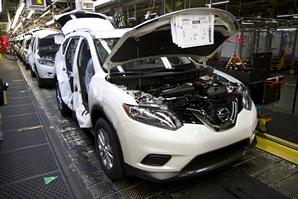
Image By: Nissan Motor Co. Ltd.
Magna makes complete tailgates for the Nissan Rogue, which is assembled in Smyrna, Tenn.
The booming North American auto industry is generating a lot of activity for both automakers and suppliers, but an official for one company said the rapid regrowth of the industry from the depths of recession opens the potential for suppliers to make more complete modules.
Auto suppliers have sought the opportunity to make complete systems – such as front-end modules, entire cockpits and roof systems – for years in North America, but the automakers have been hesitant to hand over major parts of the car.
In 2013, however, Magna International Inc. began producing complete tailgates for Nissan Motor Co. Ltd.'s Rogue crossover, made in Smyrna, Tenn.
The all olefin liftgate, with a polypropylene inner and thermoplastic polyolefin outer panel produced together with lighting, electronics and an integrated spoiler, took the top prize at this year's Society of Plastics Engineers' Automotive Innovations competition for the year.
Magna had been in talks with Nissan about making a tailgate for more than 10 years, said Tom Pilette vice president of product and process development for Magna, an Aurora, Ontario-based company. It finally won the business by offering not only a weight savings over the steel system, but because moving the module to Magna could help free up steel stamping capacity within Nissan.
Because Nissan would not longer need that stamping production for the tailgate in-house, it could dedicate that capacity to other needed parts. At the same time, Pilette said, Nissan could improve efficiency on the assembly line because it no longer needed the space or the people to do full assembly on the Rogue liftgate as it went down the line. Instead, it attaches a complete gate delivered by Magna, which requires fewer people.
"There are several hundred operations on an assembly line, and if you can reduce the number of inches needed between cars, that's big," Pilette said.
Reducing the space and personnel on the line means getting more cars per hour down that line, which leads to a higher production capacity with the same number of workers and assembly stations.
"It might only be 10,000 or 15,000 more vehicles (per year), but what if 15,000 vehicles could be the break-even point on your investment," he said.
Nissan spokesman Justin Saia agreed that there were some assembly line efficiencies in Smyrna with the new tailgate, but noted that the module is only part of the improvements on site there to improve production.
Saia noted that the Smyrna plant is capable of producing six different products, while the assembly plant in Canton, Miss., can turn out nine different vehicles. That combination allows it to faster respond to changes in demand.
New assembly plants like Nissan's in both Tennessee and Mississippi – along with those of its competitors – make it possible to produce more complex modules like the tailgate, Pilette said.
Suppliers are interested in pursuing complete systems because they can add more value on those parts, and they can take part in development far earlier.
"We're involved on a modular level a year before we would be on a component level," he said.
For the Rogue, early involvement also leads to an improved product. Magna engineers were able to design a system that would allow for a tight fit and finish with the steel panels – even with the thermal expansion issues that are typically a problem for thermoplastics. The Rogue's liftgate expands and contracts out, so rather than contracting and leaving a wider gap between body panels, the gate expands outward, very slightly increasing the wheelbase of the car.
Producing more modules off-site in supplier facilities increases the complexity for suppliers, but Pilette noted that suppliers including Magna have been making front-end modules, instrument panels, doors panels and other systems that require a variety of parts for years. Something like a tailgate just extends the logistics to another part.
"For the most part, almost all of the hurdles to (modular production) have been handled," he said.
And the North American auto market simply must adapt production to keep up with the growing demand. During the recession, Pilette said, automakers shut down unneeded facilities and cut back production.
The North American auto industry is expected to top production levels of 15 million vehicles for 2013, recovering from less than 10 million just four years ago.
"You think about how much net capacity was taken out in 2009, and how we're back at some of those same numbers in terms of vehicle production now. We're getting the same number of vehicles out, but with more efficient capacity." |